Your Q2 2023 deadlines for the diary

Anna Stubbs • March 28, 2023

As ever, we want to keep you on the ball with the latest dates and deadlines for your business diary. Get your online calendar fired up and highlight some of the upcoming deadlines and cut-off points for Q2 of 2023.
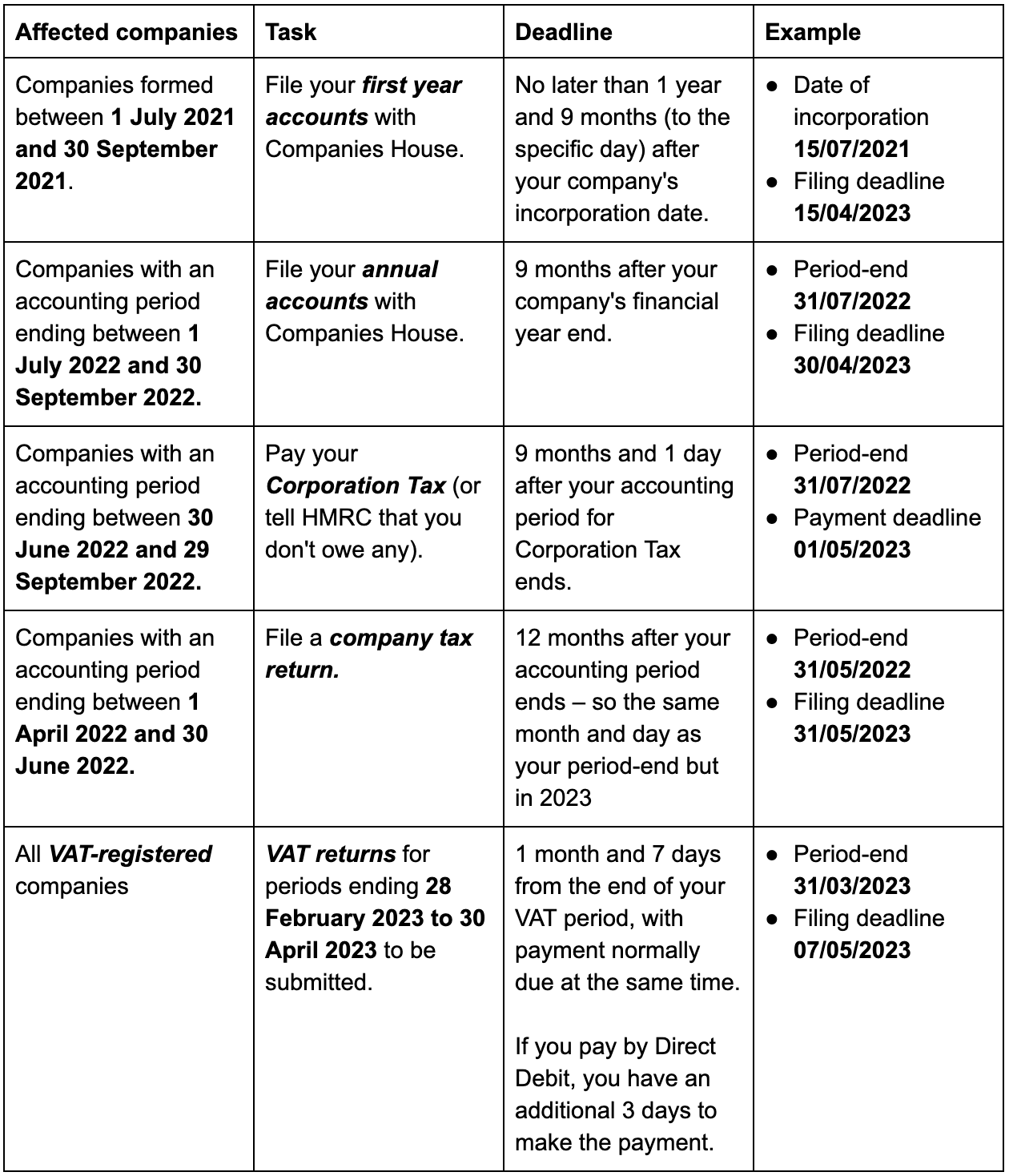
NOTE: If your company’s accounting period is longer than 12 months, the first tax payment deadline is normally 21 months and 1 day after your accounting period started, and the second one is 9 months and 1 day after your accounting period ends.

For example, a company with an accounting period running from 01/06/2021 to 30/09/2022 will pay the first tranche of corporation tax by 01/03/2023 and the balance by 01/07/2023

If your profits are more than £1.5 million, then tax is payable quarterly with two payments before the end of your accounting period and two after. The first payment is normally six months and 13 days after the start of the period, with the others three-monthly from that point.

Some general deadlines to plan for:

  • End of personal/payroll tax year: 5 April 2023, but practically speaking, for monthly payrolls the last one processed in the tax year is to 31 March 2023
  • Provide P60 to employees (for 2022/23 tax year): 31 May 2023
  • Enterprise Management Incentives Scheme notice of options granted: within 92 days of grant
  • Make Capital Gains Tax payment for gains on residential property: 60 days after completion
  • PAYE and National Insurance Payments due: 19th calendar day of the month after end of month or quarter as applicable (22nd for electronic payments)
  • File P35 (Employer Annual Return) and P14: 19 May 2023

Talk to us about hitting your deadlines

If we’re doing your payroll processing and tax returns etc., we’ll be monitoring your dates automatically – but don’t forget that you remain legally responsible for meeting all deadlines.

Keep an eye on all the upcoming deadlines and check the upcoming dates for all relevant activities. Pay particular attention to those where we don't carry out the task for you. Missing a compliance deadline can result in fines and penalties, so it’s good practice to keep everything well-organised and on time.

Get in touch to discuss your deadlines.

By Anna Stubbs January 29, 2026
Having adequate access to adequate funding is fundamental for any startup. In the early stages of getting your enterprise off the ground, you need working capital to reach the all-important minimum viable product (MVP) stage, rent premises and hire staff. But where does this initial funding come from? Let’s look at the UK Government's Start Up Loan scheme and the funding options it offers.
By Anna Stubbs January 29, 2026
Question: “Can cost-saving measures in the business truly be a key driver of profits?” Running a profitable business is one of your key goals as an owner. Without profits, there’s no capital to reinvest in the business, no funds to grow the company and no money for your own dividend payment at the end of the financial year. So, is cost-saving the answer in these challenging economic times? Answer: “Careful management of costs is a fundamental way to improve your profit margins and profitability as an enterprise” Cost-saving measures will have a direct and measurable impact on your profits. This is usually achieved via two main mechanisms. Firstly, reducing your variable costs (like raw materials or direct labour) increases your gross profit margin. This retains more revenue from each sale you make as a business. Secondly, lowering fixed overheads (such as rent or software licenses) directly reduces the total expenses on your profit and loss statement, leading to a higher net profit. This immediate bottom-line improvement makes you a more financially healthy prospect to investors and lenders – which, in turn, can often make it easier to access funding and grow the business. Want to know more about cost-saving measures?  Talk to the team about your profit goals and we’ll advise you on the key ways you can reduce your overheads and expenses to drive improved profits.
By Anna Stubbs January 29, 2026
We all hope that our pathway along the business journey will be smooth and uncomplicated. But the reality is that accidents can happen, along with unplanned injuries, damaging weather events and legal suits from disgruntled clients. So, what can you do to protect your business from these potential negative consequences? The answer is to take out the relevant business insurance for your company.